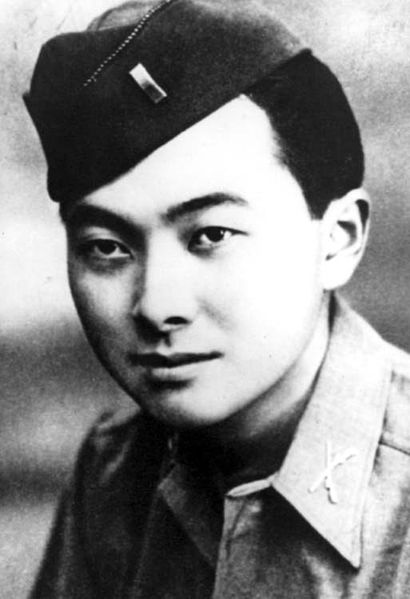
Daniel K. Inouye, a Medal of Honor recipient from his service during
World War II and, as Hawaii's senior Senator, the longest-serving member
of that body, died Monday at the Walter Reed National Military Medical
Center from respiratory complications. He was 88.
On 1943, when the U.S. Army dropped its ban on Japanese-Americans, Inouye curtailed his premedical studies at the University of Hawaii and enlisted in the Army. He volunteered to be part of the all-Nisei 442nd Regimental Combat Team. This army unit was mostly made up of second-generation Japanese Americans from Hawaii and the mainland.
Inouye was promoted to the rank of sergeant within his first year, and he was given the role of platoon leader. He served in Italy in 1944 during the Rome-Arno Campaign before his regiment was transferred to the Vosges Mountains region of France, where he spent two weeks in the battle to relieve the Lost Battalion, a battalion of the 141st Infantry Regiment that was surrounded by German forces. He was promoted to the rank of second lieutenant for his actions there. At one point while he was leading an attack, a shot struck him in the chest directly above his heart, but the bullet was stopped by the two silver dollars he happened to have stacked in his shirt pocket. He continued to carry the coins throughout the war in his shirt pocket as good luck charms until he lost them shortly before the battle in which he lost his arm.
On April 21, 1945, Inouye was grievously wounded while leading an assault on a heavily-defended ridge near San Terenzo in Tuscany, Italy called Colle Musatello. The ridge served as a strongpoint along the strip of German fortifications known as the Gothic Line, which represented the last and most dogged line of German defensive works in Italy. As he led his platoon in a flanking maneuver, three German machine guns opened fire from covered positions just 40 yards away, pinning his men to the ground. Inouye stood up to attack and was shot in the stomach; ignoring his wound, he proceeded to attack and destroy the first machine gun nest with hand grenades and fire from his Thompson submachine gun. After being informed of the severity of his wound by his platoon sergeant, he refused treatment and rallied his men for an attack on the second machine gun position, which he also successfully destroyed before collapsing from blood loss.
As his squad distracted the third machine gunner, Inouye crawled toward the final bunker, eventually drawing within 10 yards. As he raised himself up and cocked his arm to throw his last grenade into the fighting position, a German inside fired a rifle grenade that struck him on the right elbow, severing most of his arm and leaving his own primed grenade reflexively "clenched in a fist that suddenly didn't belong to me anymore". Inouye's horrified soldiers moved to his aid, but he shouted for them to keep back out of fear his severed fist would involuntarily relax and drop the grenade. As the German inside the bunker reloaded his rifle, Inouye pried the live grenade from his useless right hand and transferred it to his left. As the German aimed his rifle to finish him off, Inouye tossed the grenade off-hand into the bunker and destroyed it. He stumbled to his feet and continued forward, silencing the last German resistance with a one-handed burst from his Thompson before being wounded in the leg and tumbling unconscious to the bottom of the ridge. When he awoke to see the concerned men of his platoon hovering over him, his only comment before being carried away was to gruffly order them to return to their positions, since, as he pointed out, "nobody called off the war!"
The remainder of Inouye's mutilated right arm was later amputated at a field hospital without proper anesthesia, as he had been given too much morphine at an aid station and it was feared any more would lower his blood pressure enough to kill him.